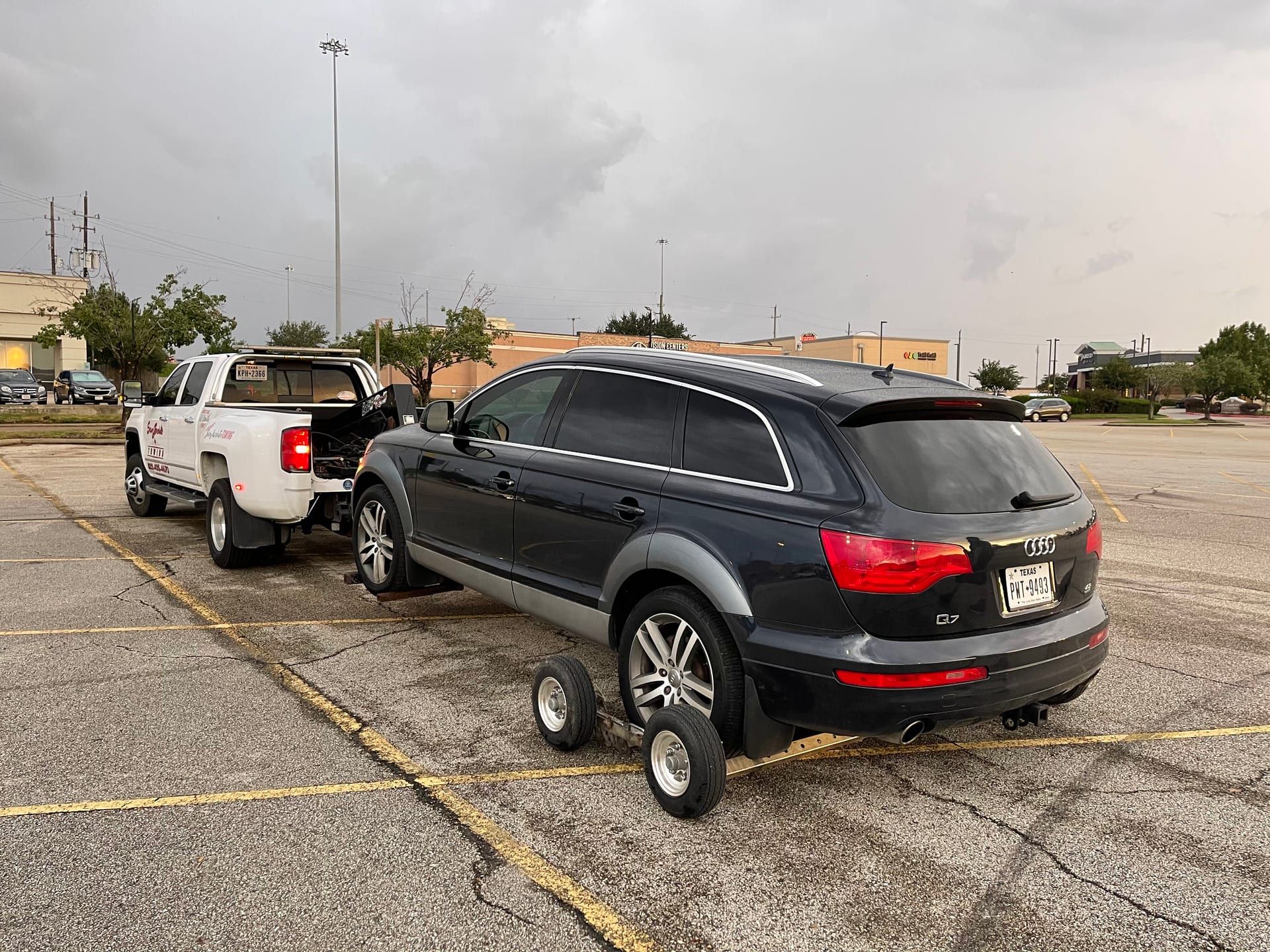
"How much does a tow cost in Houston?" is one of the questions we get asked most — usually on the phone, usually by someone whose car is on the side of the road, usually with traffic in the background.
The honest answer is "it depends" — but that doesn't help anyone planning ahead. So this guide gives you the actual ranges in 2026, what changes the price, and how to make sure you're not getting taken for a ride.
On This Page
Quick reference — Houston tow pricing in 2026
| Tow type | Typical hookup | Per-mile after first 5 mi | Real-world all-in (10-mile tow) |
|---|---|---|---|
| Light-duty (cars, small SUVs, pickups) | $75–200 | $4–8 | $115–240 |
| Medium-duty (½-ton+ trucks, larger SUVs, small RVs) | $250–500 | $5–10 | $300–600 |
| Heavy-duty (semis, big rigs, buses, large RVs) | $500–1,500 | $10–20 | $600–1,750 |
| Wheel-lift (luxury / low-clearance vehicles) | $125–250 | $4–8 | $165–290 |
| Flatbed (preferred for AWD, 4WD, exotics, classics) | $125–275 | $4–8 | $165–315 |
These are honest ballparks for the Houston metro. Crosby and the eastern corridor are usually on the lower end of each range; deep west Houston and into Katy can be higher because of distance and traffic.
The four things that bump every tow up
If your tow came in higher than the table above, it's almost always one of these:
1. Distance
The first 5 miles are usually built into the hookup fee. Past that, every mile counts — and "10 miles" on a freeway in Houston traffic can take an hour, which means the operator is on the clock. A tow from Crosby to The Woodlands is going to cost more than a tow from Crosby to Crosby.
2. Recovery work
A "tow" assumes the vehicle is on flat ground, ready to hook. The moment any of these are true, you're in recovery territory — billed differently:
- The vehicle is in a ditch
- The vehicle is rolled or on its side
- The vehicle is stuck in mud, sand, or soft ground
- The vehicle is below the road surface (off an embankment)
- The vehicle is tangled with a guardrail, tree, or other obstacle
Recovery is hourly, requires winch and rigging, and uses heavier equipment. A light-duty winch-out is typically $150–450. A heavy-duty rotator job for a jackknifed semi can run $1,500–$5,000+ for a multi-hour scene.
3. After-hours, holiday, or storm-day calls
Some tow companies run a separate after-hours rate sheet. We don't — we charge what the job costs. But the reality is that 2 AM calls, holiday calls, and storm-day calls often involve more recovery work, slower response (because of conditions), and longer scene time. So the bill is naturally higher even at the same per-hour rate.
4. Wait time
If the operator gets to the scene and you're not there, or you're waiting on police clearance, or you're still talking to your insurance company on the phone — meter's running. Most operators include 15–30 minutes of wait time in the hookup fee. After that, hourly.
What insurance actually pays for
Most drivers think their insurance covers tows. Some of them are right. Here's the breakdown for Texas in 2026:
Comprehensive coverage — covers a tow that results from a covered loss (theft, vandalism, weather/flood, hitting an animal). It does NOT cover mechanical-breakdown tows — those need a roadside-assistance rider. Reimbursement is up to your policy limits.
Collision coverage — covers tow after an at-fault accident. Same limits structure.
Roadside-assistance rider — covers tow for mechanical breakdowns. Almost always has a per-tow cap, typically $75–150. Anything above the cap is on you.
Other party's liability — if you're rear-ended and not at fault, the other driver's policy covers your tow. But the other carrier has to accept the claim first (often weeks), so you'll likely pay out of pocket and get reimbursed later.
No coverage — if you have liability-only and the tow isn't part of a covered incident, you're paying the full bill.
The single biggest mistake we see: drivers assume "I have full coverage" means tows are unlimited. Almost no Texas auto policy works that way. Before you call a tow operator, take 60 seconds to check your policy or call your carrier — knowing your cap helps you decide between a 5-mile tow to a closer shop or a 30-mile tow to your usual mechanic.
For a deeper dive on the paperwork side, see our insurance claims and towing guide.
Storage — the meter that keeps running
If you can't pick your vehicle up right away, storage is charged by the day — and Texas rules let a facility bill for any part of a day, so the meter can start the day your vehicle arrives. Some operators waive the first day as a courtesy; don't count on it. One break in your favor: if the vehicle is in and out within 12 hours — even overnight across two calendar days — the lot can only charge one day.
| Vehicle | Daily storage (TDLR cap at licensed VSFs) |
|---|---|
| Cars, small SUVs, half-ton pickups | up to $22.85 |
| Larger pickups, full-size SUVs, vans | up to $22.85 |
| RVs, motorhomes, large trailers (25 ft+) | up to $39.99 |
| Semis, box trucks, buses, heavy equipment | up to $39.99 |
Current as of August 2026. These are the TDLR-adjusted caps that took effect January 1, 2024, and they are still the amounts published on the state's own towing consumer information page. TDLR re-adjusts them for inflation on a two-year cycle, so check that page rather than trusting a figure you read anywhere — including here — if you are reading this well after 2026.
Those caps bind licensed Vehicle Storage Facilities — the regulated lots where non-consent tows go. A private lot storing a vehicle at your own request sets its own rate, so ask before you leave it. A vehicle that sits 30 days runs about $685 at the standard capped rate (up to ~$1,200 for an oversize unit). Pick it up as soon as you reasonably can, even if you're waiting on insurance — you can always tow it from your shop later if needed.
What an honest itemized receipt looks like
Texas requires tow operators to provide an itemized receipt on request. A clean one breaks the bill into:
- Hookup / base fee — what it costs to put your vehicle on our truck
- Mileage — per-mile after the included radius
- Recovery / winch — if applicable, with hourly rate and time on scene
- Wait time — if applicable
- Storage — daily rate × days
- Administrative / release fee — typically $25–75; covers paperwork
- Tax — Texas sales tax on storage charges, if any (the tow itself isn't sales-taxable, but vehicle storage is)
If your receipt just says "Tow services — $475" with no breakdown, that's a red flag. Ask for it itemized. Reputable operators will give it to you without complaint.
How to avoid getting overcharged
Five things you can do, today, before you ever need a tow:
1. Save a tow company you trust to your phone. When you're stressed on the side of a freeway, you're not in a great state to compare quotes. The first tow company that finds you (or that the police call) often isn't the one you'd have picked.
2. Know your insurance roadside cap. A 60-second call to your carrier today saves you a $300 surprise later.
3. Ask for a range before they roll. Any honest operator will quote a range over the phone based on location, destination, and vehicle type. If they refuse, that's data.
4. Ask for the itemized receipt at delivery, not later. Texas law is on your side. It's harder to dispute charges after you've paid and left.
5. Confirm the destination before they hook. A "we'll figure it out" tow can become a "stuck at the wrong shop" problem. Have an address ready.
What we charge at Smith Towing
We're a 24/7 family-owned operator out of Crosby, running light-duty through heavy-duty (Peterbilt rotators, integrated wreckers, flatbeds, wheel-lifts). We're TWIC-certified for refinery and Port of Houston work.
Our policy is simple:
- Phone quote first — we'll give you a tight range before we send a truck
- Itemized receipt every time — no asking required
- Same rate sheet day or night — we don't penalize you for breaking down at 2 AM
- Fleet pricing for repeat customers — apartment complexes, HOAs, fleet operators get pre-negotiated rates
If you want a real number for a real situation, call us at (832) 360-7122. We'll ask three questions (where, where to, what's wrong) and quote a range in under a minute.
When the cheapest quote is the most expensive option
A few last warnings, because we see the aftermath weekly:
- A $50 tow quote from someone with no website, no Google profile, and a personal cell number is going to cost you more — either at delivery (when the price magically tripled) or later (when your bumper is dented and the operator has no insurance to cover it).
- A "free tow with body shop estimate" is a marketing tactic that locks you into a specific shop. Sometimes that shop is great. Sometimes it isn't. You always have the right to choose your own.
- "We work directly with your insurance" is fine — but your insurance still pays your policy cap, not whatever the operator charged. The difference comes out of your pocket.
The good news: a competent tow in Houston doesn't have to be a mystery. Ask for the range, ask for the receipt, and you'll know what you're paying for.
Need a tow right now? Call (832) 360-7122 — we serve all of Houston, Crosby, Baytown, Kingwood, and the eastern corridor 24/7.
FREQUENTLY ASKED QUESTIONS
LATEST BLOGS
NEED HELP RIGHT NOW?
Our dispatcher picks up personally. No voicemail, no queue.