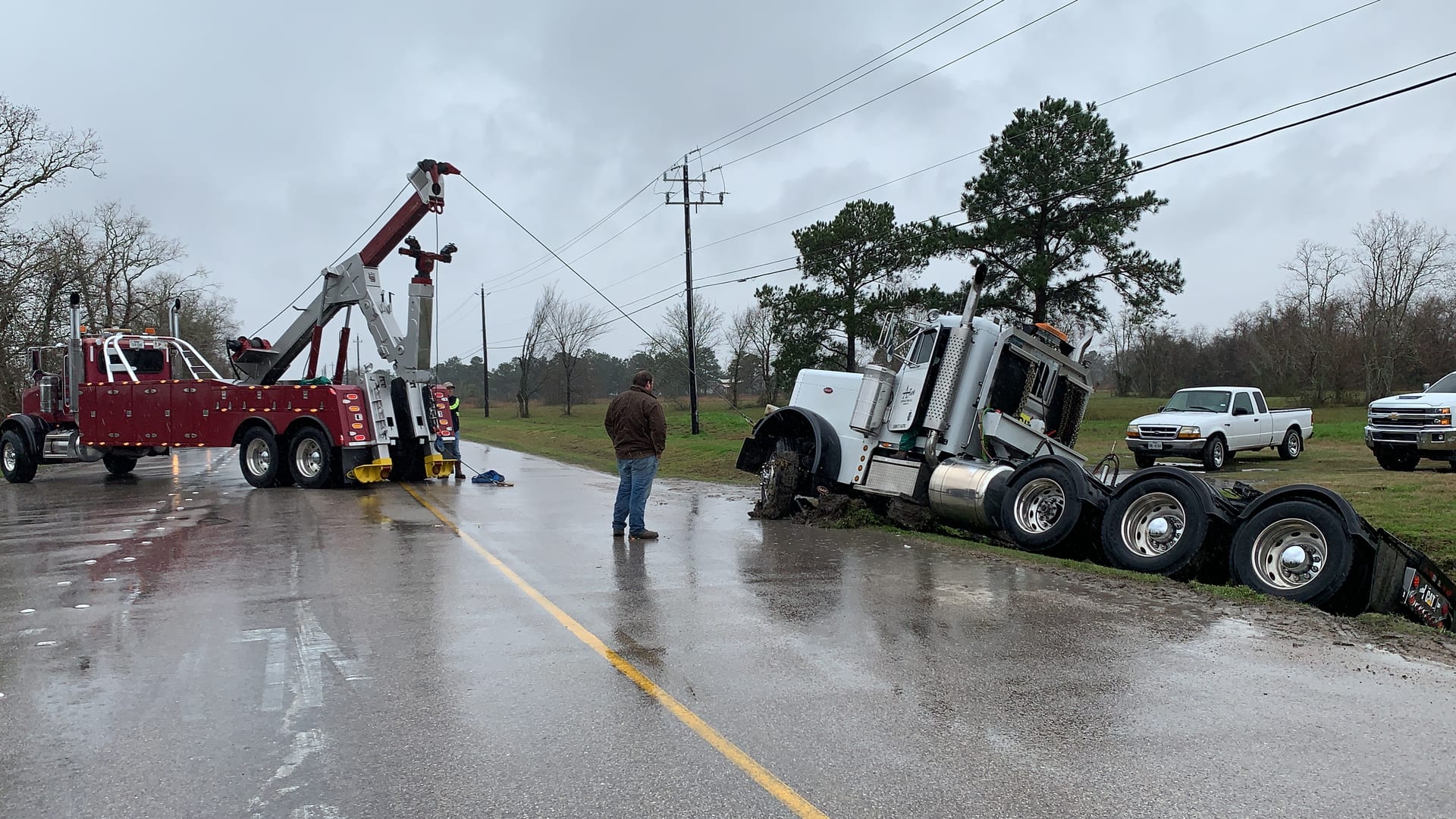
A loaded tractor-trailer that goes down on a Texas interstate is a different problem than a car on the shoulder. The rig is heavy, it is often blocking a live lane, and getting it moved without a second incident takes a rotator and an operator who has done it before. This is the playbook for drivers and fleet managers — what to do in the first ten minutes, who to call, how heavy recovery actually works, and what it costs. (Updated June 2026.)
We run heavy and semi recovery statewide from our Crosby base near Houston, so this is the same advice we give the fleet dispatchers and owner-operators who call us off the I-10 and I-69 corridors every week.
On This Page
Quick answer: what to do when a big rig goes down on a Texas highway
In order: get to safety, mark the scene, fix your location, then call a heavy-duty operator. The single most important move is getting people out of the danger zone before anything else. The truck can be recovered; you cannot be un-hit.
- Get everyone behind the barrier — out of the cab, off the roadway, behind the guardrail, away from live lanes.
- Make the rig visible — hazards on, reflective triangles out at the spacing your CDL training taught you.
- Fix your exact location — highway, direction of travel, and the nearest mile marker or exit number.
- Call a heavy-duty recovery operator — not a standard tow company (more on why below).
- Fleets: call your on-file provider — one number that already knows your account beats searching at 2 a.m.
Step 1 — Get safe before anything else
Get out of the cab and behind a barrier first. More than half of the people killed on highway shoulders are outside their stopped vehicle, so the cab and the roadside are exactly where you do not want to stand while you wait.
Texas takes this seriously on the other side too: under the state's Move Over / Slow Down law, drivers must move over or slow down for stopped tow trucks and emergency vehicles, and a violation carries a fine of $500 to $1,250 for a first offense (a Class A misdemeanor if someone is hurt). That protects the recovery crew once we arrive, but in the minutes before that, your own safety is on you. Behind the guardrail, hazards on, triangles out.
Step 2 — Know who to call (a big rig is not a regular tow)
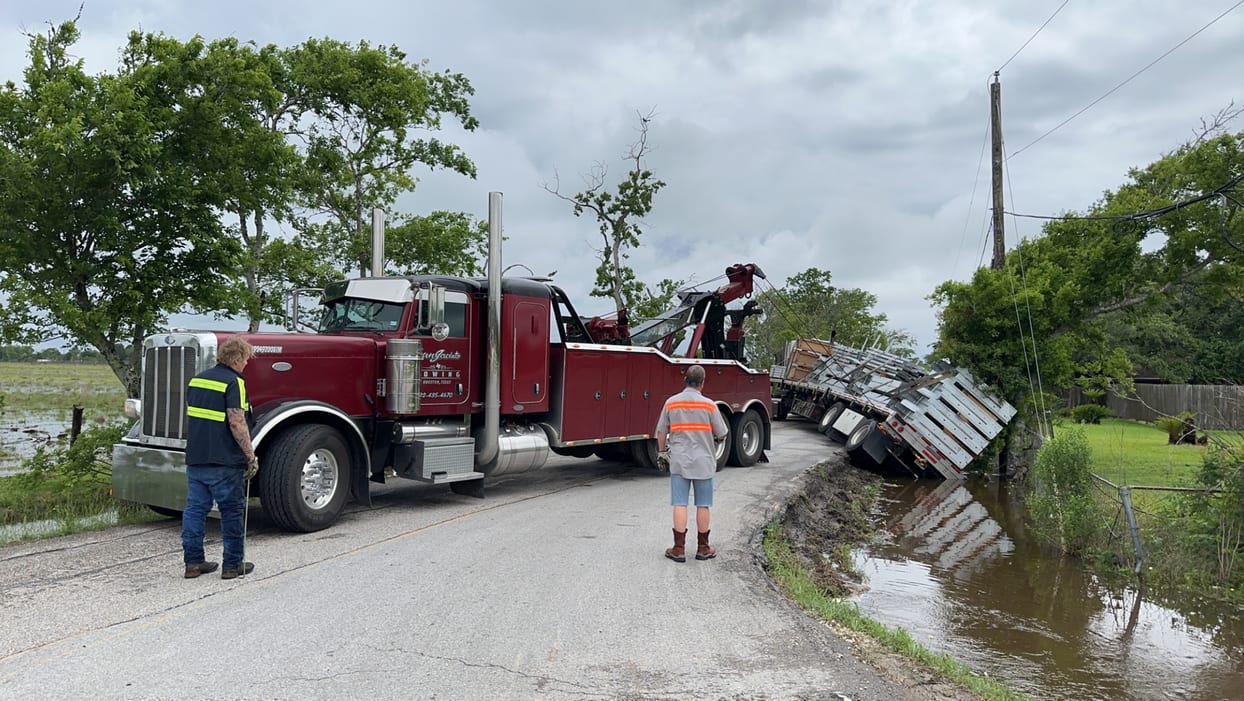
Call a heavy-duty recovery operator, not the first tow truck that comes up in a search. A loaded Class 8 can weigh up to 80,000 lbs. A standard wheel-lift cannot touch a rig that is loaded, jackknifed, or on its side. That takes a rotator, the right rigging, and an operator who reads the angle and the terrain before the boom comes up.
That is the bottleneck in heavy recovery: not how close a tow truck is, but whether the right equipment and the right hands actually show up. It is why we dispatch heavy gear across distance for the big jobs — see our statewide heavy-duty & semi recovery page for how that works across the Texas corridors.
What heavy recovery actually involves
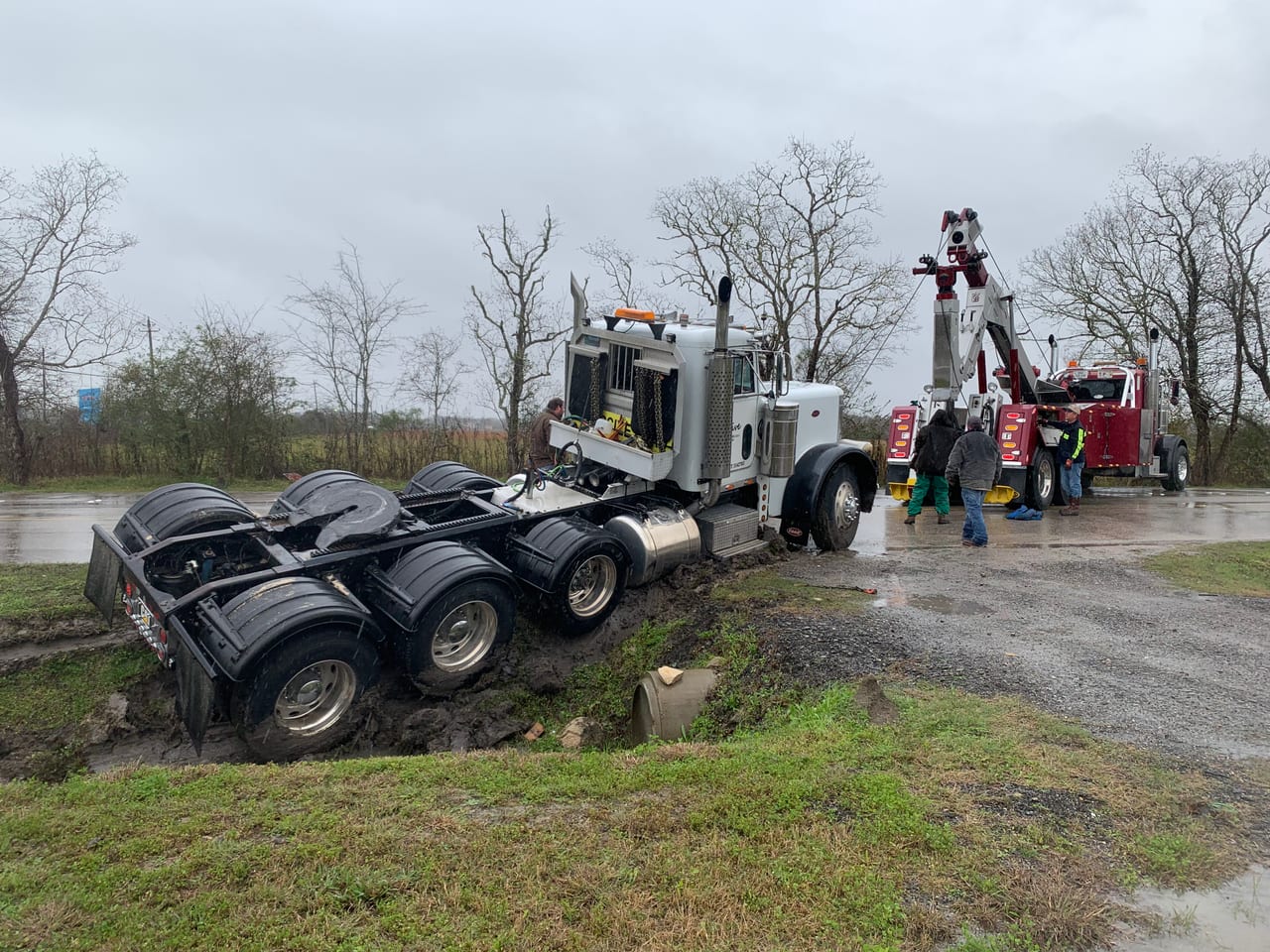
Once you are safe and we are rolling, here is what the recovery looks like. We bring a rotator and a rigging plan matched to the weight and the angle, upright or winch the rig without adding to the damage, and — if the trailer can no longer carry its load — re-secure or transfer the cargo onto a sound trailer so it moves once, cleanly.
Behind that is the equipment that makes it possible: 50- and 75-ton rotators, a 35-ton heavy wrecker, and an NRC carrier that hauls dozers, forklifts, and shipping containers, with recovery capacity up to 80,000 lbs. Our operators are TWIC-certified for port and plant access, and we have run heavy and commercial work out of our own Crosby yard since 2001.
How much does it cost to recover a semi in Texas?
Heavy recovery is priced per job, not as a flat rate: it depends on the weight, the recovery angle, the rigging required, and the hours on scene. A straightforward disablement is a different number than a loaded rollover down an embankment.
What you should expect from any reputable operator: a quote up front, before the truck rolls, and an itemized receipt at the end. Know which rules apply here: if the rig is off the roadway and not affecting traffic, a recovery you request is a consent tow, priced by agreement. If it is blocking a lane, Texas classifies the job as an incident-management tow even when you call it in — and statewide rate caps only exist for private-property tows, so any incident-tow caps come from the city or county. Either way, the up-front quote is your real protection, not a state cap. If a provider will not quote the job or explain the line items, that is your signal to call someone else.
Will insurance cover it?
Often, yes — but it depends on the coverage. A heavy recovery can fall under a commercial auto physical-damage policy, motor truck cargo coverage, or a fleet roadside program, depending on what happened and what you carry. The one constant: keep the itemized receipt, because carriers require it to reimburse.
We tow and recover rigs; we do not give insurance advice. Confirm the specifics with your insurer or your fleet's risk manager. But practically, the faster the rig is cleared and documented, the cleaner that claim tends to go.
For fleets: set it up before the breakdown
The worst time to find a heavy-recovery provider is at 2 a.m. with a loaded trailer blocking a lane. Set it up ahead instead. We run Net-30 fleet and owner-operator accounts with PO-matched invoicing and a dedicated dispatch line, so a unit going down out of town is one call to a number that already has your account on file, not a scramble for an unknown operator.
One truck or a hundred, the setup is the same: on file, priority when you call, and the same straight pricing whether the recovery is in Crosby or three hundred miles away.
Statewide coverage along the Texas freight corridors
Texas freight runs on a handful of arteries: I-10, I-45, I-69 / US-59, I-35, and I-20. So do the breakdowns. We run heavy and semi recovery along those corridors from our 4-acre Crosby facility on the east side of greater Houston, which puts us on the I-10 and I-69 corridors fast and within reach of the rest of the state for the recoveries that justify the run.
If you move freight through Texas, the takeaway is simple: have one heavy-recovery number that does not care which county the breakdown lands in.
When you need us
If your rig is down right now: get behind the barrier, fix your mile marker, and call. A real dispatcher — not a call center — answers 24/7/365, gives you a straight ETA, and quotes the job before the truck rolls.
Call (832) 360-7122, or read more about our statewide heavy-duty and semi recovery. Family-owned since 2001, TWIC-certified, dispatched around the clock from Crosby, TX.
FREQUENTLY ASKED QUESTIONS
RELATED GUIDES
NEED HELP RIGHT NOW?
Our dispatcher picks up personally. No voicemail, no queue.