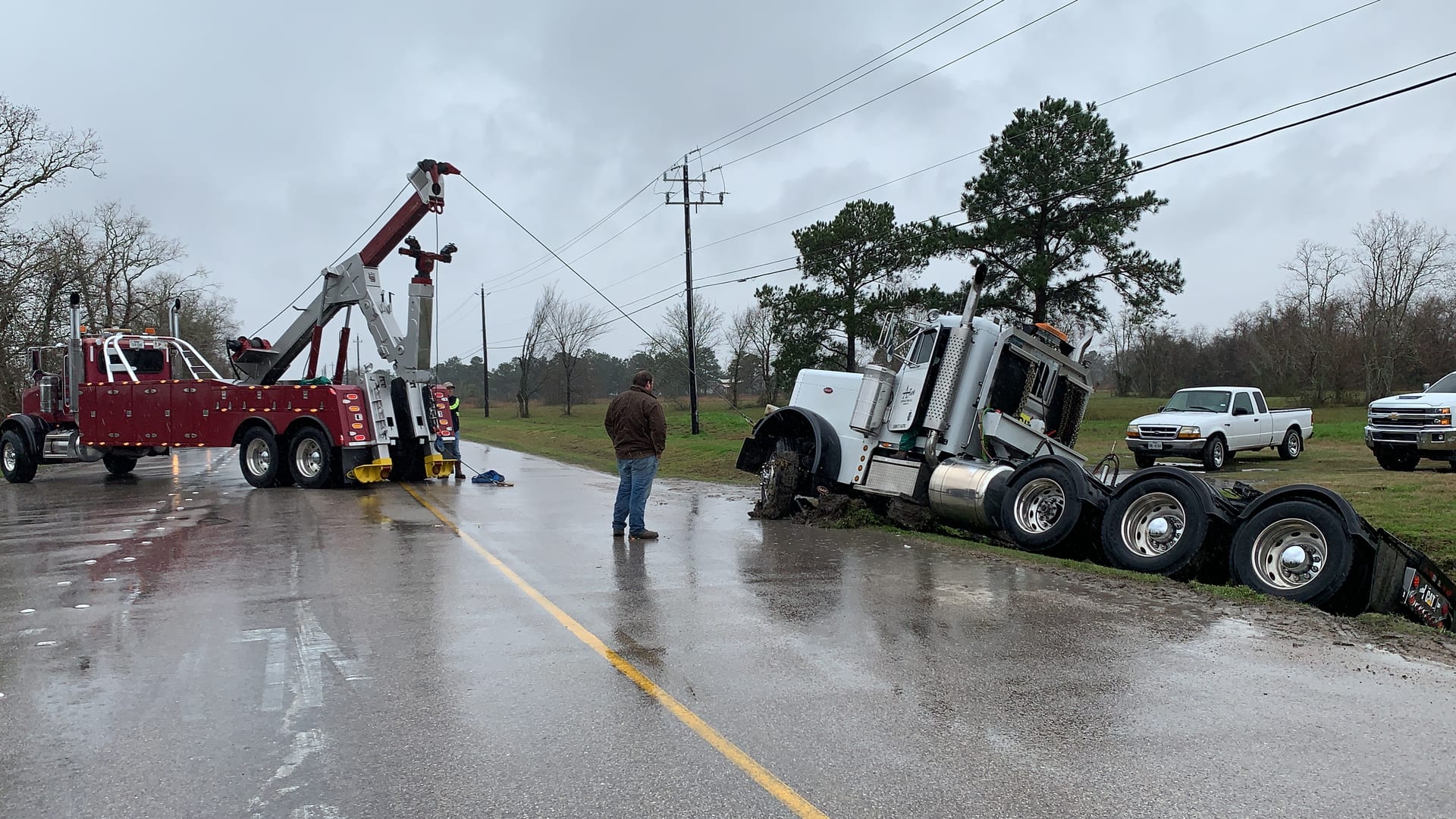
Breaking down on I-10, I-69, Beltway 8, the Grand Parkway, or the Sam Houston Tollway is one of the most stressful situations a Houston driver faces. Traffic runs at 70+ mph on both sides, shoulders are narrow, and every second you're outside the vehicle is a real risk.
This guide is the playbook our dispatchers wish every driver knew before they called us. Read it once now, save the number in your phone, and you'll be calmer when it actually happens.
On This Page
Quick answer — the 30-second protocol
If you're reading this DURING a breakdown:
- Get to the right shoulder if you have any control left. Better: take the next exit even if it's a half-mile away.
- Hazard lights ON immediately — every time, even in daylight.
- Stay inside the vehicle with your seatbelt fastened.
- Call dispatch — Smith Towing (832) 360-7122, 24/7. Tell us: nearest exit number, direction of travel, your vehicle make/model.
- Don't get out unless the vehicle is on fire or being struck.
The rest of this guide covers the why, the regional Houston specifics, and what to do AFTER the tow truck arrives.
Step 1: Get off the road if you can
The single biggest safety upgrade you can make in the first 10 seconds is continuing to a safer place. If you have any throttle, steering, or coast left:
- Take the next exit if it's within reach. A vehicle parked at a gas station off an exit ramp is dramatically safer than one on a freeway shoulder.
- Move to the right shoulder if you can't make an exit. Stay as far right as the shoulder allows — closer to the wall is better than closer to the travel lane.
- Avoid the median or left shoulder. Texas freeways are designed for emergency exits to the right. The left side is much harder for a tow truck to reach safely.
If you're on the Sam Houston Tollway, Hardy Toll Road, or Grand Parkway, the shoulders are generally wider — but don't go looking for roadside hardware; your own phone is your fastest link to help.
Step 2: Hazard lights, immediately
The moment you start slowing down, flip on your hazard lights. Don't wait until you're stopped. Drivers approaching from behind at highway speed need that warning as early as possible.
Keep them on the entire time you're stopped, even after a tow truck arrives. Tow trucks have their own warning lights, but yours add to the visibility cone.
If your car's electrical system is dead and the hazards won't work, raising your hood and tying a white cloth to your antenna or door handle is the old-school equivalent. Texas DPS troopers and tow operators recognize the signal.
Step 3: Stay in the vehicle
This is the rule that saves lives. Unless your vehicle is on fire or in immediate danger of being struck, stay inside with your seatbelt fastened.
The shoulder of a Houston freeway is one of the most dangerous places a person can be. Common patterns:
- A driver glances at their phone and drifts onto the shoulder.
- A blown tire sends a vehicle careening sideways across two lanes.
- Rain reduces visibility enough that a stopped vehicle isn't seen until it's too late.
Your steel cage and airbags are the protection you have. Don't trade them for a stretch of asphalt.
If you must exit the vehicle (fire, smoke, structural damage, medical):
- Exit on the passenger side, away from traffic.
- Move as far from the road as you can — climb the embankment, get behind a guardrail, anything.
- Stay there until emergency services arrive.
Step 4: Call for help
From inside your vehicle, with your seatbelt on:
- Emergency (crash, injury, fire, threat): dial 911 first, then a tow company.
- Mechanical breakdown (flat, overheat, dead battery, alternator, fuel): call a tow company directly. 911 dispatchers will refer you to one anyway, and direct calls are faster.
- Out of fuel: also a tow-company call. We carry gas and diesel and can fuel you in place, usually cheaper than a tow.
- Unsure: 911 can coordinate. They have your phone's location and can route the right responder.
One more option worth knowing, because it's free: the regional Tow and Go program (713-881-3333), run by the Houston-Galveston Area Council — it replaced the city's old SafeClear program — will move a vehicle with a mechanical breakdown off the freeway to a nearby safe spot at no charge. Know its limits: it covers the camera-monitored freeways, not the tollways (Sam Houston, Hardy) or the Katy managed lanes, and it's for attended mechanical breakdowns, not crashes. And it exists to clear the lane, not to get you home: once you're somewhere safe, you'll still need a tow to your shop or driveway, and that's a call to a company you choose.
Smith Towing & Recovery dispatches 24/7 from Crosby, TX. (832) 360-7122. A real dispatcher answers: no call center, no voicemail tree.
What to tell the dispatcher
The faster you can answer these questions, the faster a truck rolls:
- Exact location — nearest exit number, mile marker, direction of travel (e.g., "I-10 west between Beltway 8 and Highway 6, on the right shoulder past the Eldridge exit").
- Vehicle description — year, make, model, color (helps the operator find you in heavy traffic).
- Nature of the problem — breakdown, accident, out of fuel, flat tire, dead battery. We send different equipment for each.
- Whether the vehicle is drivable — affects truck choice. A car that can roll onto a flatbed is a different job than one that's stuck.
- Your callback number — in case the route changes or the operator needs to reach you mid-drive.
- How many people are in the vehicle — including kids, pets, anyone with mobility limits. Affects whether we need to bring extra cab room or coordinate a separate ride.
Speak in short, direct sentences. We've taken thousands of these calls; we know what to ask.
What NOT to do
The shortlist of things that get drivers hurt or fleeced:
- Don't try to change a tire on the freeway shoulder. Wait for the tow truck. A roadside tire change on a Texas highway with a 70-mph speed limit is physics waiting to happen.
- Don't accept help from random strangers offering to push, tow, or give you a ride. Houston has a recurring scam where unlicensed "tow operators" prowl freeways, hook a vehicle, and charge $400+ at a remote yard before releasing it. Real tow operators wait to be dispatched.
- Don't pay cash to anyone without an itemized receipt and TDLR license number on it. No paperwork, no insurance reimbursement, no recourse if something gets damaged.
- Don't panic. Breakdowns are common. Every dispatcher and operator at Smith Towing has handled thousands. Stay in the vehicle, stay on the phone, you're fine.
Houston-specific corridor notes
Different freeways have different breakdown realities. The dispatcher will adjust the response based on which one you're on.
I-10 (Katy Freeway, East Freeway): the busiest east-west corridor. Construction zones west of Beltway 8 are tight; rush hour heading into downtown sits dead 7–9 AM and 4–7 PM. Let dispatch know if you're west of 99; response time is longer.
I-69 / US-59 (Eastex / Southwest Freeway): narrow shoulders north of Loop 610, especially through Kingwood and Humble. Take the next exit if you have any control left.
Beltway 8 (Sam Houston Tollway): wide shoulders, faster response from Crosby for the east and north sides. Toll points are NOT a substitute for an exit; keep moving past them if you can.
Grand Parkway (99): newest of the major loops, good shoulder room, but cell service is still spotty in some far west and south sections. If you can't reach dispatch, dial 911; DPS troopers (the Texas Highway Patrol) work the corridor and can relay.
Hardy Toll Road / Sam Houston Tollway North: lots of overhead signage gantries, narrow shoulders in the original sections. Take an exit if you can.
Loop 610: older, tightest shoulders of any Houston freeway. If you lose power on 610, take whichever exit reaches you first — north, south, east, or west loop, doesn't matter.
Texas Move Over law
Texas Transportation Code §545.157 requires drivers approaching a stopped emergency or maintenance vehicle (including tow trucks with flashing lights) to either:
- Move one lane away from the stopped vehicle (if possible), OR
- Slow to 20 mph below the posted speed limit if the limit is 25 mph or higher (and to 5 mph if the limit is below 25 mph).
Violation carries a fine of $500–$1,250 for a first offense, and rises to a Class A misdemeanor (up to $4,000 and jail time) if injury results. Most drivers comply, but enough don't that staying in your vehicle behind the tow truck, not standing alongside it, is the right call.
At night, in rain, with kids or pets
Night: turn on the dome light briefly when emergency vehicles approach so they can see you inside. Keep the dome OFF the rest of the time so it doesn't drain the battery further.
Rain: Houston rain is famously heavy and brief. If you can wait 15 minutes in a covered location for the worst of a band to pass before being towed, that's safer for both you and the tow operator. Dispatch can hold the truck at a nearby exit until visibility improves.
Kids or pets in the car: tell dispatch upfront. Most heavy-duty tow trucks can carry 1–2 passengers in the cab. If you have more, we'll coordinate a ride from the tow yard or arrange a follow vehicle. Pets ride with you in most cases.
Medical needs: if you or someone in the vehicle has a medical condition that requires medication or temperature control, mention it. Dispatch will prioritize your job and may coordinate with EMS as needed.
After the tow truck arrives
The operator will:
- Confirm your name and the vehicle.
- Set up safety cones and warning lights to protect the work zone.
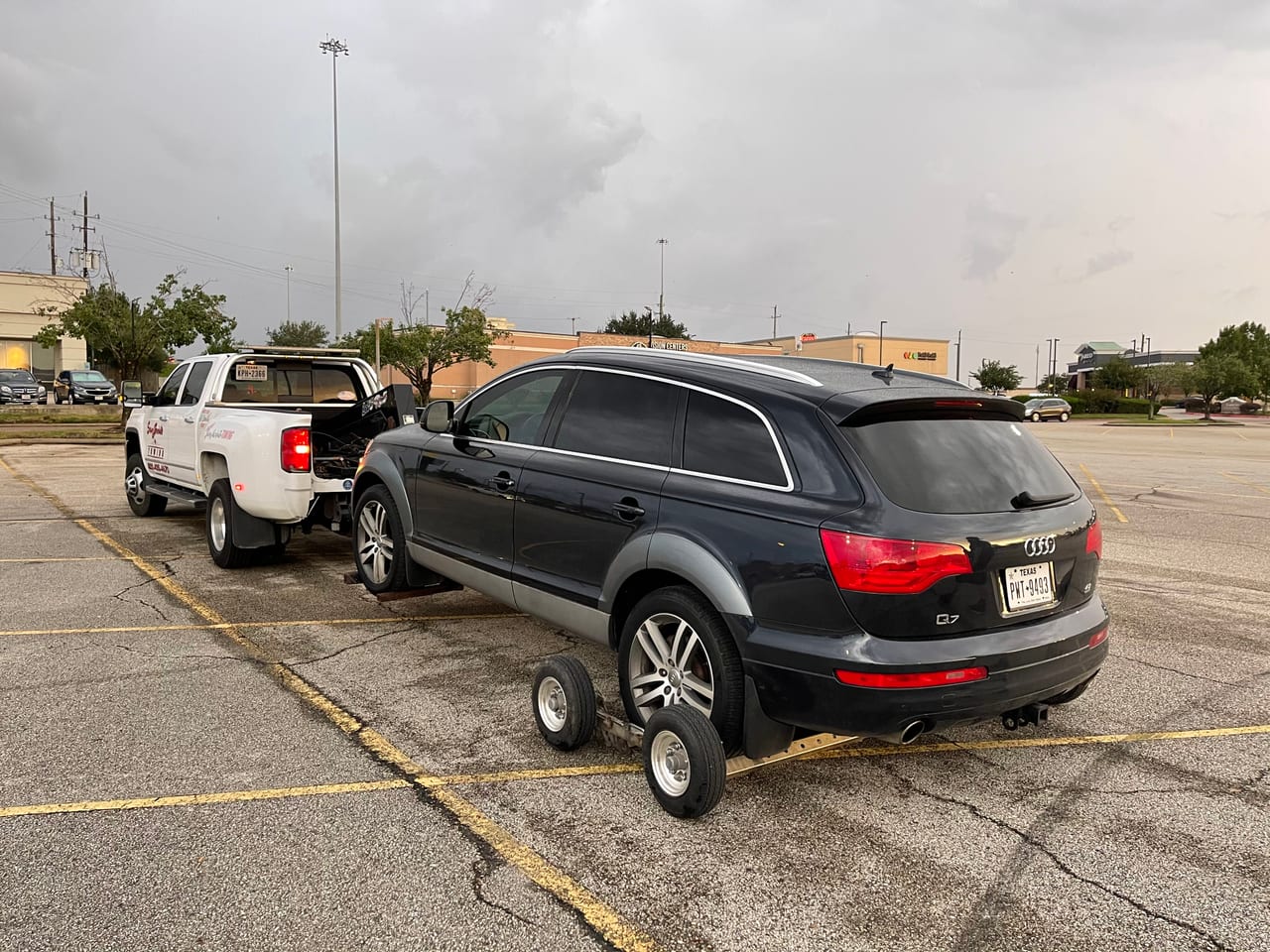
- Hook up using a flatbed or wheel-lift, depending on your vehicle.
- Provide a tow ticket with the TDLR license, license plate, and destination.
- Drive you (and passengers) to the destination — repair shop, your house, our storage facility, or wherever you choose.
Save the receipt. It's required for insurance reimbursement, warranty claims, and in some cases TxDOT incident records.
Cost expectations
Light-duty (cars, SUVs, small pickups): $125–$225 base + $4–$6 per loaded mile beyond the included radius. Median Houston freeway tow under 15 miles: roughly $150–$250.
Medium-duty (box trucks, large SUVs, big pickups): $250–$450 base.
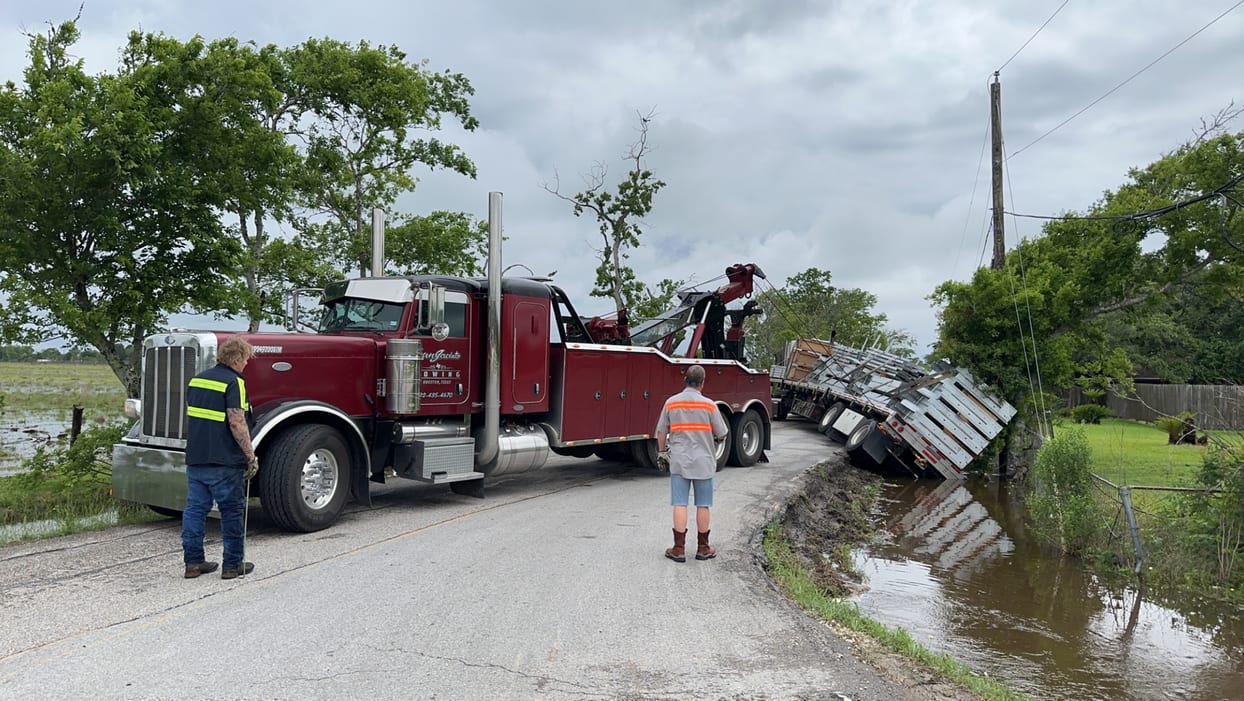
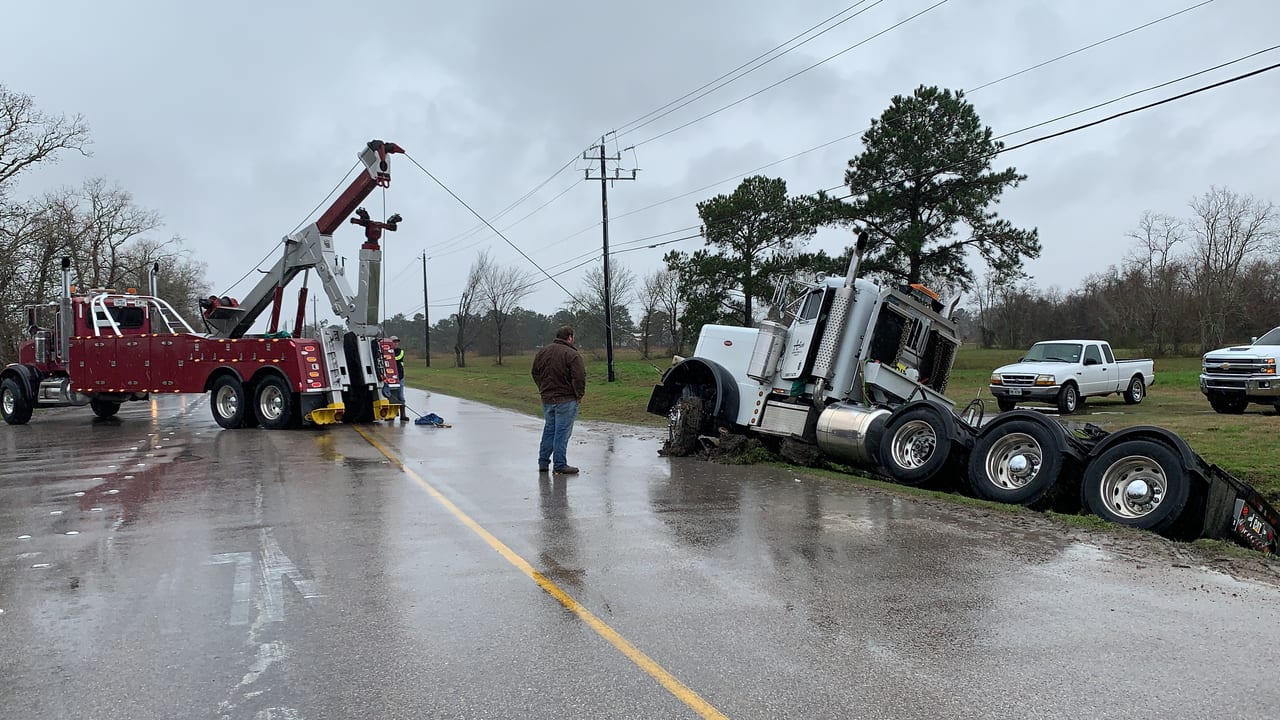
Heavy-duty (semis, RVs, buses): $500+ base, scaling with rotator and winch time. Heavy recoveries are quoted job-by-job.
Roadside assistance (jump start, fuel delivery, lockout, tire change): $75–$150.
We quote upfront. No "after you're hooked" surprise charges. See our pricing transparency policy for the full breakdown.
Common scams to avoid on Houston freeways
Houston has a documented problem with bandit tow operators: unlicensed trucks that monitor scanner traffic and arrive before a dispatched operator does, then refuse to release the vehicle without inflated cash payments at a remote storage yard.
Protect yourself:
- Don't accept a tow from anyone you didn't call. If a truck shows up before your dispatched ETA, ask which company they're from and verify with your dispatcher.
- Verify TDLR license — every legitimate operator carries it. Texas Department of Licensing and Regulation maintains a public database at tdlr.texas.gov.
- Get the operator's name and the tow ticket BEFORE the vehicle goes on the truck. If they refuse, they're not legitimate.
- Don't pay cash without an itemized receipt with company name, address, license number, and your vehicle info.
Smith Towing & Recovery is TDLR-licensed (lic# available on every receipt). We dispatch from a fixed Crosby facility; we don't prowl freeways looking for jobs.
Save our number now
The single best thing you can do before you ever break down is save (832) 360-7122 in your phone. It's cheaper to have it and not need it than to be hunting for a reliable tow company with traffic whipping past your window at 70 mph.
We answer 24/7. Real dispatcher, no call center. Quote upfront, paperwork at the truck, ETAs you can plan around.
See also: light-duty towing, roadside assistance, insurance & towing reimbursement, how to find an impounded vehicle. Stranded on I-10 east? We cover Channelview, Baytown, and Highlands.
FREQUENTLY ASKED QUESTIONS
RELATED GUIDES
NEED HELP RIGHT NOW?
Our dispatcher picks up personally. No voicemail, no queue.