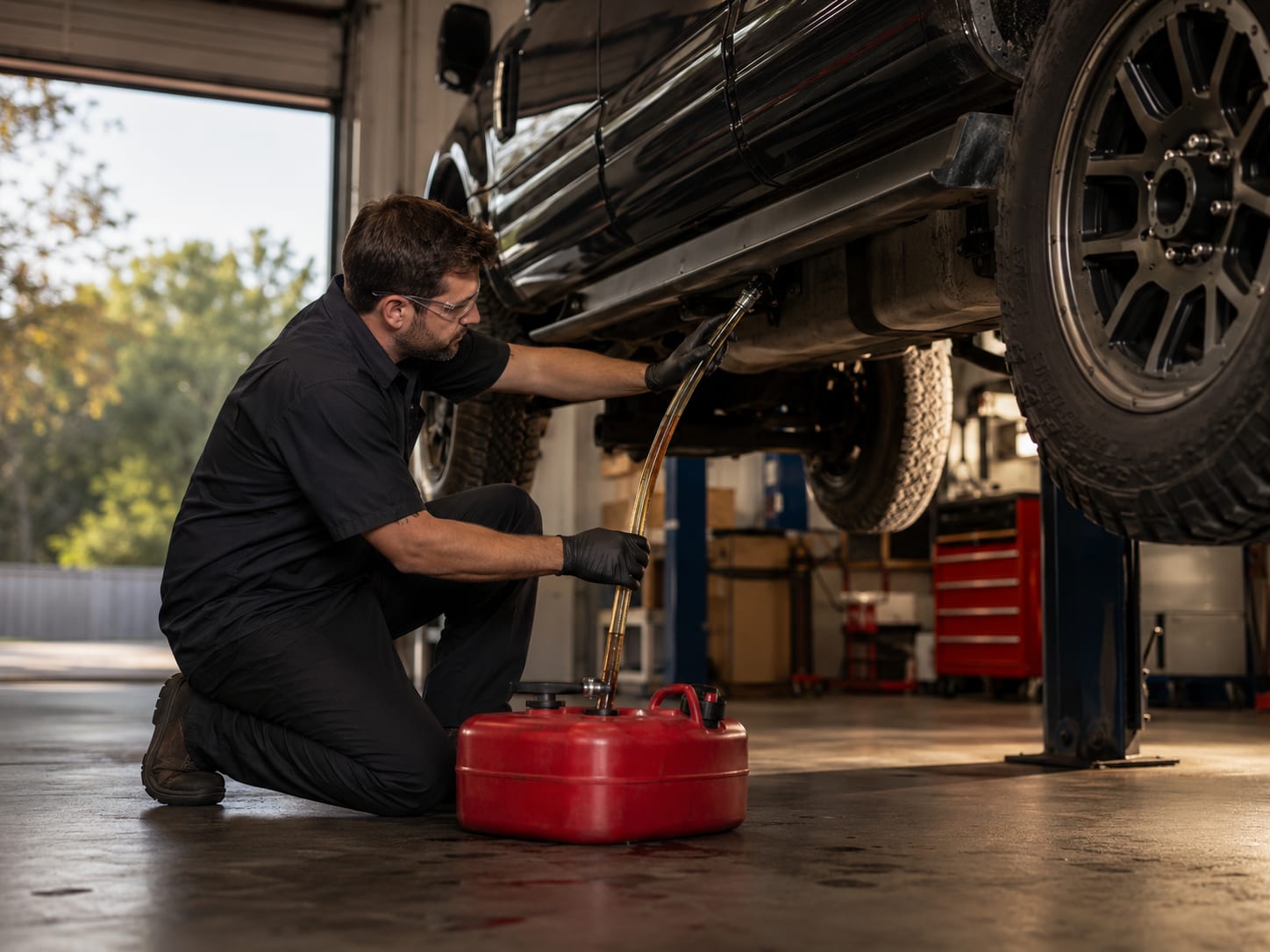
WRONG FUEL & DEF DRAIN
Gasoline in a diesel? DEF in the fuel tank? Don’t start the engine — call us.
DON’T START THE ENGINE
If you just put gasoline in a diesel vehicle, or DEF in the diesel fuel tank, the single most valuable thing you can do is nothing mechanical. Don’t start it. Don’t turn the key to “on.” Don’t crank it to see whether it runs. On a modern diesel the in-tank pump energizes the moment the ignition wakes up and begins pulling fuel toward the engine before it ever fires.
Here is the reassuring part: while the wrong fuel is still sitting in the tank, the problem is contained to the tank. Caught before the engine has been run, a proper drain and flush usually returns the vehicle with no lasting damage. Turning the key is what pushes contamination through the high-pressure pump and injectors and turns a straightforward drain into a major repair.
This is work we do often. We tow the vehicle to our own diesel shop in Crosby, drain the tank and fuel lines, replace the filters, and refill with clean diesel — frequently back to you within 24 hours. Because the tow and the shop are both ours, nothing sits waiting on a second vendor.
WHAT WE HANDLE
- Gasoline in a diesel tank
- DEF (diesel exhaust fluid) in the diesel fuel tank
- Diesel accidentally put in the DEF tank
- Complete tank drain & fuel-line flush
- Fuel filter & water-separator replacement
- Tank drop when a tank has no drain plug
- Diesel pickups, work trucks & fleet vehicles
- Post-drain inspection if the engine was already run
WHY GASOLINE IN A DIESEL IS SO DAMAGING
On a modern diesel, the fuel is the lubricant. The high-pressure fuel pump and the injectors have no separate oil supply — they are lubricated by the diesel itself, running at extreme pressure with very tight tolerances. Gasoline is thinner and acts as a solvent, stripping that protective film away. The result is metal-on-metal contact inside components that are expensive to replace, and fine metal debris that travels through the rest of the fuel system.
Gasoline also burns wrong in a compression-ignition engine. A diesel relies on heat from compression to ignite fuel at a controlled moment; gasoline resists that and then ignites unpredictably, which is the knock and rough running you never want to hear out of a diesel. On modern common-rail engines there is no genuinely safe amount of gasoline — but if it is still sitting in the tank and the engine was never started, none of that has happened yet.
DEF IN THE FUEL TANK — A DIFFERENT MISTAKE, THE SAME FIRST MOVE
DEF (diesel exhaust fluid) is roughly two-thirds deionized water and one-third urea. It is designed to be sprayed into hot exhaust in the SCR after-treatment system, not burned in the engine. In the fuel tank it causes trouble three ways at once: it has no lubricity at all, the urea is corrosive to the metals in your fuel system, and as it dries it forms hard crystalline deposits that clog filters and injector passages. You cannot filter it out and you cannot dilute it away.
It is an easy mistake to make. On a lot of diesel pickups the DEF fill sits right beside the diesel fill, sometimes under the same door, and a driver in a hurry — or one in an unfamiliar work truck — reaches for the wrong one. The rule is identical either way: don’t start the engine, and get the tank and lines drained.
The reverse mistake, diesel poured into the DEF tank, is a separate problem. It damages the DEF dosing system and the SCR catalyst rather than the engine’s fuel system, and it needs a DEF-side drain and flush. The first instruction is still the same — don’t run it.
WHAT NOT TO DO WHILE YOU WAIT
Almost every expensive misfuel starts with a helpful instinct. Don’t start the engine to see whether it runs — that is the single costliest move, and it is what turns a drain into a repair. Don’t turn the key to accessory or crank it to check anything, because energizing the system is enough to begin priming the wrong fuel forward.
Don’t top off with diesel hoping to dilute it. Gasoline and DEF are not neutralized by more diesel; you simply create a larger volume of contaminated fuel that has to come back out, and you tempt yourself into driving. And don’t nurse it to a shop under its own power, even a mile down the road — a short drive runs the contamination through the injection system at full pressure, which is exactly the damage worth avoiding.
If you have already started it, shut it down and leave it off. Some harm may already be done, but every additional minute of runtime makes it worse, and draining promptly is still the cheapest path left. Tell us plainly whether it was started and how far it went — that one fact shapes the whole job more than anything else.
HOW THE DRAIN WORKS AT OUR SHOP
We come out and tow the vehicle in. Towing matters more than it sounds like it should: because the vehicle rides in rather than driving in, the engine never has to start, and the contamination never gets pulled past the tank. That is the same protection a roadside drain would give you, without anyone having to work a fuel job on a shoulder or a fuel island.
At the shop we drain the tank completely — the full contaminated load, not just what floats on top. If the tank has no drain plug, or if it is a DEF job where residue clings and crystallizes, we drop the tank, because that is what a clean job takes. From there we flush the fuel lines and the filter housing to clear anything that made it past the tank, install fresh filters, and refill with clean diesel.
If the engine was run before we got to it, we will tell you so and check further: the high-pressure pump and injectors get inspected for metal debris, and the engine oil is worth a look, since fuel can slip past seals into the crankcase. If deeper work is needed, our diesel shop is the same building, so the repair does not start with finding another shop and another tow.
WHY THIS HAPPENS SO OFTEN AROUND CROSBY
This corner of Harris County runs on diesel. US-90 through Crosby is a freight corridor, and the Ship Channel, refinery row, and the oilfield-services belt are thick with diesel work trucks — Super Duties, Duramaxes, hotshot rigs, farm trucks, and fleet pickups running hard all day. That is precisely the setting where misfueling happens: drivers in a hurry, borrowed or rented trucks, and a DEF fill sitting an inch from the diesel fill.
It happens to careful people. It happens to professional drivers. The only thing that separates a cheap outcome from an expensive one is whether the key got turned before someone made the call, which is why we would rather you phone us from the pump than try to sort it out yourself.
FLEET, HOTSHOT & WORK-TRUCK ACCOUNTS
A misfueled truck is a truck that is not earning, so we treat these as priority jobs. Fleet customers get the same 24/7 dispatch and net-30 billing that covers the rest of our work, and because the tow and the diesel repair happen under one roof, there is one point of contact and one invoice instead of a tow company pointing at a shop and a shop pointing back.
If you run a crew that fuels in the field, it is worth a two-minute toolbox talk: the DEF fill is not the diesel fill, and if someone gets it wrong the correct response is to stop, leave the key out, and call. Getting that one instruction into your drivers’ heads is worth more than any repair we could sell you.
SERVING CROSBY & GREATER HOUSTON
We provide this service 24/7 across Crosby and the greater Houston area, including:
Crosby • Baytown • Channelview • Pasadena • Deer Park • La Porte • Kingwood • Humble • Atascocita • Highlands

FREQUENTLY ASKED QUESTIONS
WRONG FUEL IN THE TANK? DON’T START IT
Leave the key out and call. Our dispatcher picks up personally, 24/7.