
Diesel ·
Truck Stuck at 5 MPH? What a DEF Derate Means and How to Get Rolling
Your truck is crawling. The DEF light is on, the dash is throwing a message, and no matter how hard you push the pedal it will not go past 5 miles an hour. You are now a rolling roadblock, and every minute is costing you a load, a schedule, or a safe spot to pull off.
Here is what is actually happening, why the usual roadside tricks will not fix it, and how to get moving again — without paying to replace a part the truck does not need.
On This Page
Quick answer
A 5 mph derate is the last stage of a DEF/SCR inducement — the truck found an emissions fault, warned you, and stepped your speed down to force a repair. The common triggers are a DEF tank that ran empty, bad DEF quality, a clogged dosing injector, or a failed NOx sensor.
If it was purely a low-level derate and you catch it early, topping off the tank and cycling the key can bring it back. If it is anything else — or the truck has already latched into the full 5 mph crawl — adding DEF and unplugging the battery will not clear it. At that point it needs a real diagnosis and a tool reset after the actual fault is fixed.
If you are stuck at 5 mph in traffic right now, get to a safe spot and call. A crawl is not a way to limp home.
What a 5 MPH derate actually is
Every heavy truck and diesel pickup built with an SCR system has an inducement built into the engine computer. It is federally required, and its whole job is to make sure a truck with a broken emissions system cannot just keep running dirty forever. When the computer finds an aftertreatment fault it cannot resolve, it starts limiting the truck until someone fixes it.
That is the part drivers miss: your truck is not mechanically broken. It runs, it idles, the turbo still spins. It is choosing to limit you because it found a fault it wants repaired, and the 5 mph crawl is the strongest lever it has to make sure you do not ignore it.
The inducement ladder — how a warning becomes a crawl
A DEF or SCR fault does not jump straight to 5 mph. It climbs a ladder, and each rung is a chance to fix it before the next one:
| Stage | What you see | What it means |
|---|---|---|
| 1. Warning | DEF / check-engine light, dash message | A fault is active or DEF is low — your cheapest window to fix it |
| 2. Speed limit | Truck capped (often around 55 mph) | The warning was ignored or the tank hit empty; the clock is running |
| 3. Severe derate | 5 mph crawl, often after a key-off and restart | Full inducement — the truck will not move normally until it is repaired and reset |
The takeaway: the light is not the problem, the light is the window. Every stage you drive past makes the fix more disruptive and the truck harder to move off the road.
What triggers a DEF/SCR derate
| Trigger | What is going on | Fix it at the pump? |
|---|---|---|
| DEF tank ran empty | The simplest cause; the system treats empty as a quality failure | Sometimes — refill and key-cycle early |
| Poor DEF quality | Contaminated, watered-down, or wrong fluid — or a bad quality sensor | No — it has to be tested |
| Clogged dosing (reductant) injector | The nozzle that sprays DEF into the exhaust is plugged | No |
| Failed NOx sensor | The sensor reading the exhaust cannot confirm the SCR is working | No |
| Low SCR efficiency | The catalyst is no longer cleaning enough exhaust | No |
Notice how few of these you can fix at a truck stop. The one cause you can sometimes clear yourself — a tank that ran dry — is the exception, not the rule. That is the honest reality of a derate.
Why topping off DEF and unplugging the battery usually will not work
If the derate was nothing more than a low DEF level and you catch it before it fully latches, refilling with fresh, sealed DEF and cycling the key can bring the truck back after it re-reads the tank. Give it a few minutes; sometimes it wants a short low-speed drive to re-check.
But if the cause is quality, a dosing injector, or a sensor, the tank was never the issue — so adding fluid changes nothing. And the popular "just disconnect the battery" trick does not work either: the fault and the inducement are stored in memory a battery pull does not erase, so it comes right back, and you can add new electrical gremlins in the process.
⚠️ Don't just "reset the derate" to make it go away. Clearing an inducement without fixing what caused it is exactly how trucks end up derated again 40 miles down the road — with the driver stranded a second time, in a worse spot. The reset is the last step after the repair, not a substitute for it. Any shop that offers to "clear the derate" without reading DEF quality, dosing, and the NOx sensors first is selling you a second breakdown.
How to actually get rolling
If you are at 5 mph right now:
- Get off the road. A truck doing 5 mph in a live lane is more dangerous than a truck stopped on the shoulder. Find a safe spot, hazards on.
- If the only cause is a truly empty DEF tank and you caught it early, add several gallons of fresh DEF, cycle the key, and wait a few minutes.
- If it does not come back, stop trying. You have a fault, not a fluid level, and forcing key cycles will not talk it out of the derate.
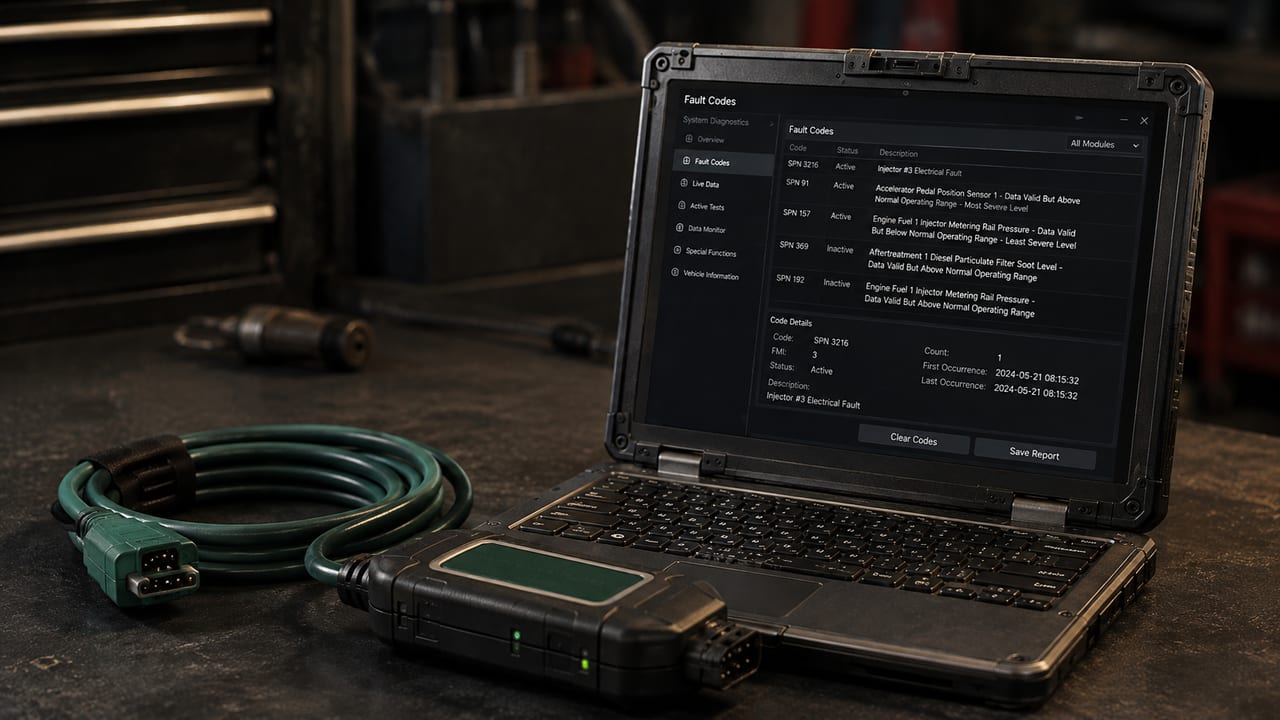
- Call for a mobile diagnosis. The fault has to be read, the real cause repaired, and the system reset with a tool. That is a straight, one-trip fix when the right gear comes to you — see our mobile diesel diagnostics page for how we work.
If the truck is derating because it cannot finish a regeneration, that is a related but different problem — see how to force a DPF regen for when a regen will and will not get you out of it.
Why we see so many of these around Houston
Texas does not inspect diesel emissions in most counties, so nothing forces a driver to repair a DEF or DPF problem for a sticker. The regional habit that comes out of that is simple: run it until it derates on the shoulder. Add in Gulf Coast heat, heavy idling, and the short port-drayage and refinery-yard hauls that never get the exhaust hot enough to keep the aftertreatment happy, and the derate call becomes an everyday event out here.
That is the call we run constantly along the I-10 and US-90 corridors and through the Ship Channel: a truck stepped down to a crawl, a driver who has already tried adding DEF, and a fault that needs a real read before anyone spends a dollar on parts.
Stuck at 5 mph on the shoulder right now? Don't keep forcing it. Call (832) 360-7122 — a real dispatcher answers 24/7, and we bring the diagnostic gear to you, find the fault behind the derate, and either get you rolling or tow you to our Crosby diesel shop. See our mobile diesel diagnostics page for how the workup goes.
FREQUENTLY ASKED QUESTIONS
RELATED GUIDES

NEED HELP RIGHT NOW?
Our dispatcher picks up personally. No voicemail, no queue.