
Diesel ·
How to Force a DPF Regen on a Semi (and When a Forced Regen Won't Save You)
Your dash is lit, the truck is down on power, and the soot level is pegged. Somebody told you to "just force a regen" — and that is often the right move. But it is also the move that gets people hurt when they run one in the wrong place, and the move that wastes an afternoon when soot was never the real problem.
Here is how a forced regen actually works, how to run one without starting a fire, and — just as important — how to know when forcing it again is a waste of time.
On This Page
Quick answer
A forced (parked) regen is a regeneration you command while the truck sits still: park in a safe outdoor spot on bare pavement, set the brake, bring the engine to temperature, and start it from the dash regen switch or a diagnostic tool. The engine then runs high and hot for 20 to 60 minutes while exhaust temperatures climb past 1,000°F to burn the soot out of the DPF.
Two things matter more than the button. First, it is a real fire and burn hazard — the exhaust gets hot enough to ignite grass or fuel and to badly burn anyone at the tailpipe. Second, it only works if the problem is genuinely soot. If the doser is not spraying, the DOC is not lighting off, a fault is blocking the regen, or the filter is fully plugged, forcing it will abort or fail — and the DPF needs cleaning or the truck needs a tow.
What a forced regen actually does
A diesel particulate filter traps soot out of the exhaust. Normally the truck cleans that filter by itself — a passive regen from highway heat, or an active regen where the computer adds heat while you drive. You never notice either one.
A forced or parked regen is different: it is you telling the truck to clean the filter right now, sitting still, because it has loaded up more soot than it can clear on its own. The engine idles high, the doser (or seventh injector) sprays a little fuel into the exhaust, the DOC lights that off, and the temperature climbs high enough to burn the trapped soot to ash. Done right, the soot number drops and the truck comes back to full power.
How to run a parked regen safely
The procedure varies by make, but the safe setup does not:
- Pick the spot first. Bare pavement, outdoors, well clear of grass, mulch, fuel, and anything that can catch. Not in a shop, not under a trailer, not over a gravel lot full of debris.
- Park and set up. Park brake on, transmission in neutral, engine at operating temperature, DEF and coolant at level.
- Clear the area. Nobody stands at or behind the exhaust outlet. Keep a fire extinguisher within reach.
- Start the regen from the dash switch or a diagnostic tool, and leave it alone. It runs 20 to 60 minutes. Do not drive it, do not shut it off early unless something is wrong.
- Watch the exhaust temperature. If it climbs and the soot number falls, it is working. If the temperature never comes up, stop — that is your signal something else is wrong (see below).
⚠️ A regen is a fire and burn hazard — treat it like one. During a forced regen the exhaust outlet and the components around it get hot enough to ignite dry grass, cardboard, or fuel vapor, and to cause a serious burn to anyone standing at the tailpipe. Never run one indoors, under a trailer, over grass or debris, or near a fuel spill. Park on bare pavement, clear the area, keep people away from the outlet, and keep an extinguisher handy until everything cools.
When a forced regen won't save you
This is the part the generic how-tos skip. If a regen keeps aborting or does nothing, the filter is not the whole story — something is stopping the burn:
| Sign during the regen | What it points to | Force it again? |
|---|---|---|
| Exhaust/outlet temp never climbs | Doser or DOC not lighting off — not a soot problem | No — diagnose the doser and DOC |
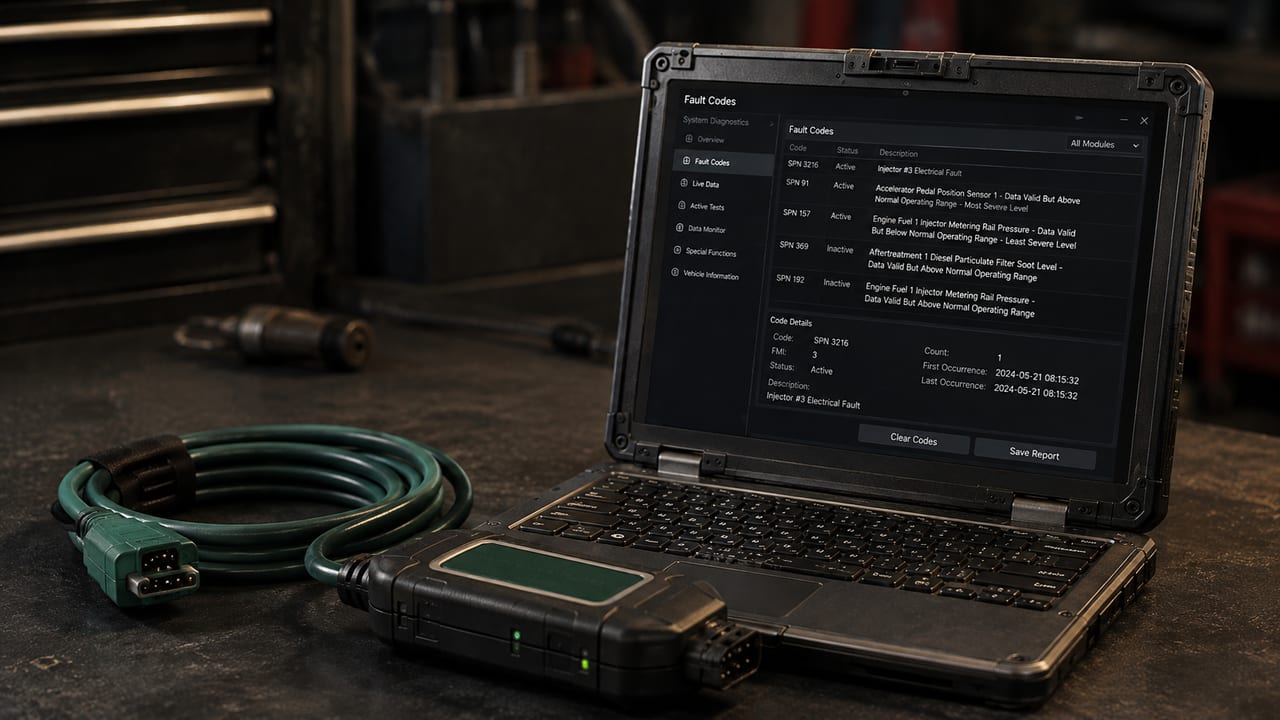
| Regen starts, then aborts every time | An active fault is blocking it | No — read the fault first |
| Soot load extreme / filter face-plugged | Past what a burn can clear | No — the DPF needs cleaning or replacement |
| Regen completes but soot returns fast | An injector, oil consumption, or a sensor is loading it | Diagnose the root cause |
The single most useful check is the exhaust temperature. If you command a regen and the outlet temp never comes up, stop forcing it — you have a doser or DOC problem, and running it again just burns fuel and time. That one observation is the difference between a $200 doser diagnosis and a wrongly-condemned $2,000 filter.
If your truck has already dropped into a speed limit or a crawl over this, that is a related problem — see what a 5 mph DEF derate means.
Why so many Houston trucks can't finish a regen
Passive regens need heat, and heat needs highway miles. A lot of the diesel work around here never gets it: port drayage, refinery-yard waiting, Ship Channel short hauls, and long idle time in Gulf Coast heat. The truck never runs hot enough long enough to clean its own filter, so soot builds until it forces a parked regen — and if a doser or DOC is marginal, that is exactly when it will not complete.
That short-haul, heavy-idle duty cycle is why we run so many regen and aftertreatment calls out of Crosby. It is also why "just force another regen" is bad advice on a truck that has aborted twice: the pattern is telling you the cause is a fault, not a filter that needs one more burn.
Can't get a regen to complete? Don't keep forcing it, and don't let a plugged filter strand you. Call (832) 360-7122 — we confirm it is actually a soot problem, run the regen safely, or diagnose the doser, DOC, or sensor fault that is aborting it. If the filter is plugged past saving, we tow it to our Crosby shop for a real DPF service and diesel repair. See mobile diesel diagnostics for how the workup goes.
FREQUENTLY ASKED QUESTIONS
RELATED GUIDES
NEED HELP RIGHT NOW?
Our dispatcher picks up personally. No voicemail, no queue.